
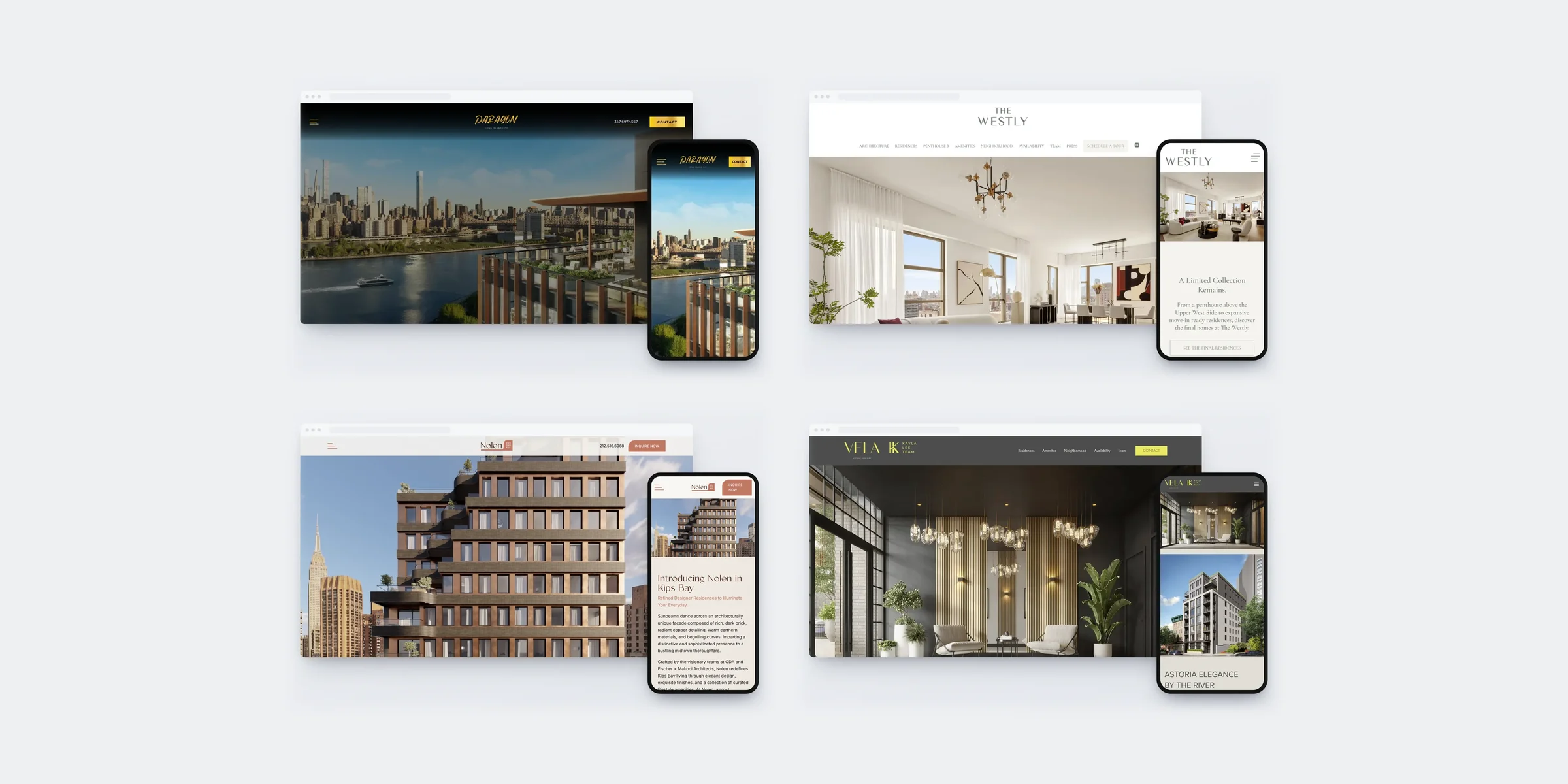
Short answer: websites for new developments are usually built by one of five kinds of teams: a branding and creative studio, a template platform, the sales brokerage's marketing team, a general web agency, or a builder that specializes in project sites. Each can work. What matters most is who owns the site, how fast it goes up, and what happens to it after the last unit sells.
I've built more than 50 websites for new developments in New York and Miami, from boutique condos in Greenwich Village to towers in Long Island City. This guide is what I'd tell a developer choosing a website partner for their next project, including the parts that only show up years later.
The five kinds of teams that build developer websites
1. Branding and creative studios
These studios name the project, design the identity and often produce the renderings and the sales gallery materials. The website is one piece of a larger campaign.
Good fit when: you need the whole brand created from nothing and have the budget for it. Ask: who actually builds the website, and who updates it after launch. Some studios design the pages and hand the build to someone else.
2. Template and subscription platforms
You pick a layout, add your photos and pay monthly. They're quick to launch and include hosting.
Good fit when: speed and a low starting cost matter more than a look that matches the project. Ask: what happens when you stop paying. On most platforms the site goes away with the subscription, and you can't take the design with you.
3. The sales brokerage's marketing team
Many brokerages that handle new development sales also produce the project website. It's convenient, because the people selling the building are the ones keeping the site current.
Good fit when: you expect to work with the same brokerage through sellout. Ask: who owns the domain and the site if you change brokerages, and whether you get the files.
4. General web agencies
Agencies that build sites for every kind of business can build a good project site, especially if they've done one before.
Good fit when: you already trust the agency. Ask: to see project sites they've launched, and how they handle availability, floor plans and registrations. Those are the parts a general agency is most likely to learn on your project.
5. Builders who specialize in project sites
Smaller teams, like ours, that design and build new development websites as their main work. They know the pieces a sales team needs and usually move faster.
Good fit when: you want a custom site without a full branding engagement, or you already have a brand and renderings. Ask: whether they can create the brand too, or whether you'll need a separate studio for that.
What a new development website needs
- A teaser site with registration as soon as you have a name and a rendering, so early interest isn't lost while the full site is designed.
- Residences as real pages, not PDFs: browse by bedrooms, open a floor plan, ask about that unit. Availability your team can update the same day.
- Renderings, finishes and amenities presented in the project's own look, not a template's.
- The neighborhood: a map of transit, parks, schools and shops nearby.
- Registrations that go straight into your sales CRM, with an automatic reply so buyers hear back right away. For most new developments that CRM is Spark.re (more on that below).
- Booking for the sales gallery or model unit.
- Required disclaimers. In New York, condo marketing has to say that the complete offering terms are in an offering plan available from the sponsor, with the file number. Equal housing language belongs in the footer.
- Speed and accessibility on phones, where most buyers will see the site first.
Connect the website to Spark
Many new development sales teams run on Spark.re. If yours does, the website's registration form should feed it directly. When registrations land in an inbox and someone types them into Spark by hand, leads slip, and nobody can tell how many buyers the website actually brought in.
A good Spark connection does four things:
- Every registration becomes a Spark contact with name, email and phone, no copying or importing.
- The registration source is set, so your team can see how many contacts came from the website.
- Your custom fields are filled in: residence size, price range, whether the buyer works with a broker.
- Your team still gets an email for each registration, as a backup.
To set it up, your Spark admin creates an API key for the project and shares the registration source to use. We map each question on the form to a Spark field, send test registrations, and go live once they show up correctly. When you compare website partners, ask whether they've connected a site to Spark before, and ask to see the registration land in Spark during testing.
The question most developers forget: what happens after sellout
A project website keeps working long after the last unit sells. The domain is in press coverage, on the building's Google Business Profile, on Instagram and on listing sites. When the site is taken down, or the domain lapses, every one of those links leads to an error page. In the worst case someone else buys the domain and puts their own site on it.
We checked the project sites in our own history and found more than a dozen that had gone dark this way after changes in ownership or marketing teams. Before you sign, decide:
- Whose name the domain is registered in. It should be the developer's, not a vendor's.
- Whether you get the site's files and content if you change partners.
- What the site becomes after sellout: a leasing site, a resale and building information page, or a simple page that keeps the address alive and points to the developer's next project.
Questions to ask before you hire anyone
- Can I see three project sites you've launched, and are they still live?
- Who designs it, who builds it and who updates it after launch?
- Can my team update availability and pricing without waiting on you?
- Can registrations go straight into Spark.re (or our CRM), with the source and custom fields filled in?
- How fast does a buyer get a reply after registering?
- Who owns the domain, the design and the content?
- What happens to the site when sales end or we change brokerages?
- How fast can a teaser site go live?
Our work on new developments
Some of the project sites we've built: Paragon LIC, The Westly, 277 Fifth Avenue, 475 Kent Lofts, Nolen, La Maison Collette, Vela Astoria, Wynd Miami, 29 Indian Creek and Quay Tower. Many were built with SERHANT's new development team. Some we designed and built from scratch; others, like Quay Tower, we built from SERHANT's designs.
If you have a project coming to market, see new development website design or websites for developers, or tell us about the project.